System Architecture
On Horizon, the login nodes provide access to the system for compiling, job submission, data transfer, etc. While the login nodes are configured similarly to the compute nodes, they are not intended to be used for computational jobs. Instead, they serve as your gateway to the rest of the system.
The architecture of the Horizon system is very similar to that of its much smaller forerunner, Vista, which is shown in the diagram below. Not only is Horizon far larger than Vista, but its components are individually more powerful, as they incorporate NVIDIA's next-generation hardware. The key CPU and GPU enhancements are noted in the diagram. Still, even with these differences, the node types in Horizon and their general configuration are analogous to those in Vista.
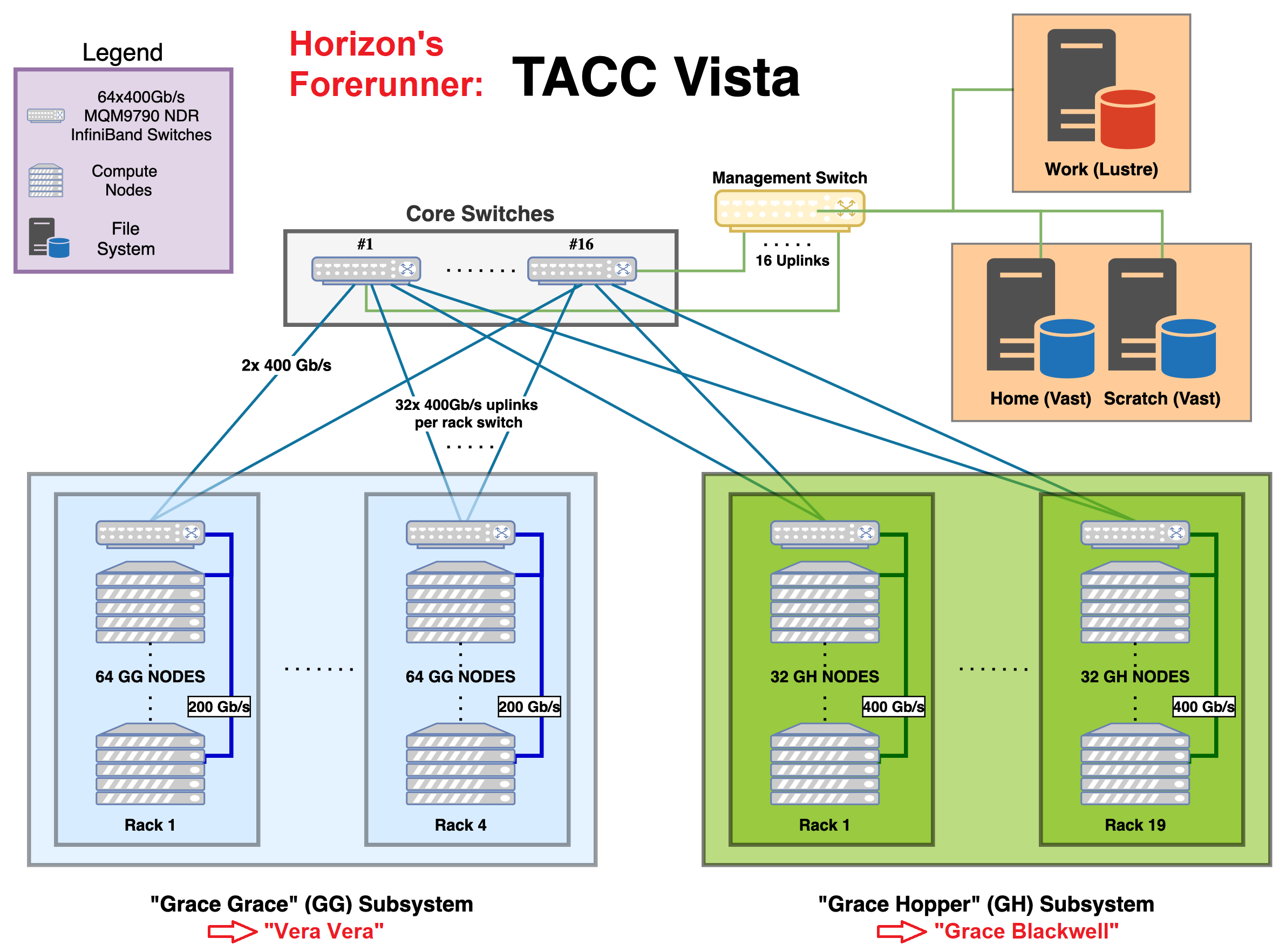
Horizon's extensive, interconnected array of compute nodes is intended for running large-scale jobs in batch or interactive mode. The compute nodes in the "Vera Vera" (VV) subsystem have one NVIDIA Vera CPU Superchip consisting a pair of 88-core Vera processors, for a total of 176 cores per node. Compute nodes in the "Grace Blackwell" (GB) subsystem have two NVIDIA GB200 Grace Blackwell Superchips consisting of four NVIDIA B200 GPUs, and two 72-core Grace CPUs. We’ll look at the full details of these nodes shortly in the Compute Nodes section.
The NVIDIA XDR InfiniBand interconnect ties all these components to each other and to the various high-performance storage systems. Note that Horizon's main file systems and storage will be covered in a subsequent topic, Storing and Moving Data.
CVW material development is supported by NSF OAC awards 1854828, 2321040, 2323116 (UT Austin) and 2005506 (Indiana University)