From Scalars to Functions - The Conceptual Leap
Let's start with something familiar and build our intuition.
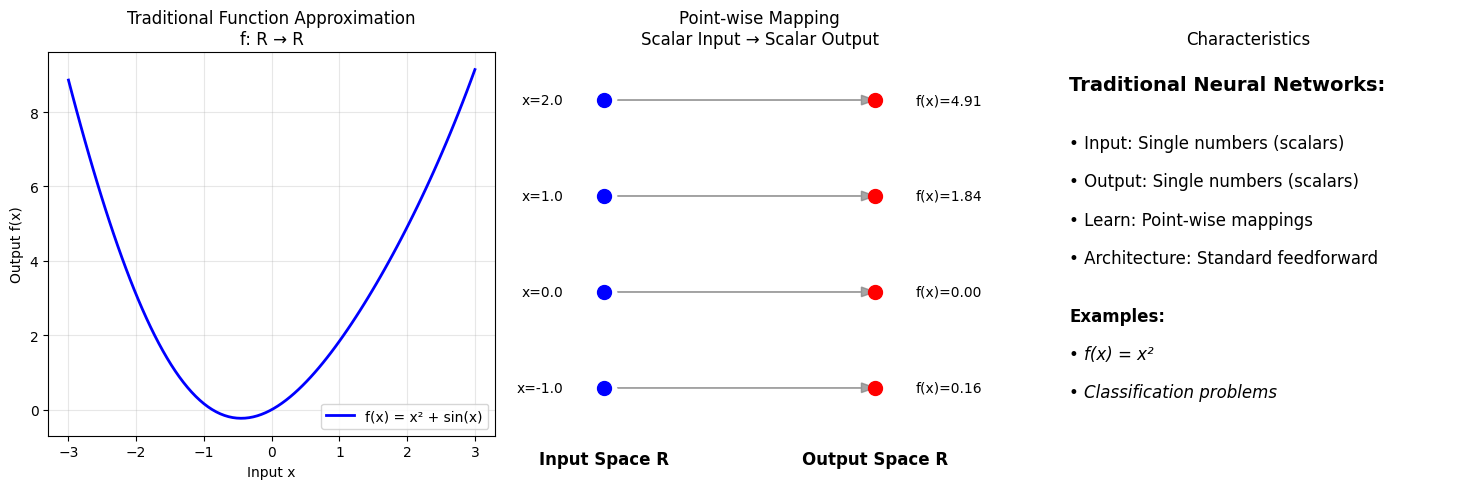
Traditional Function Approximation
We know neural networks can learn mappings like:
- Input: A number \( x = 2.5 \)
- Output: A number \( f(x) = x^2 = 6.25 \)
This is point-wise mapping: each input point maps to an output point.
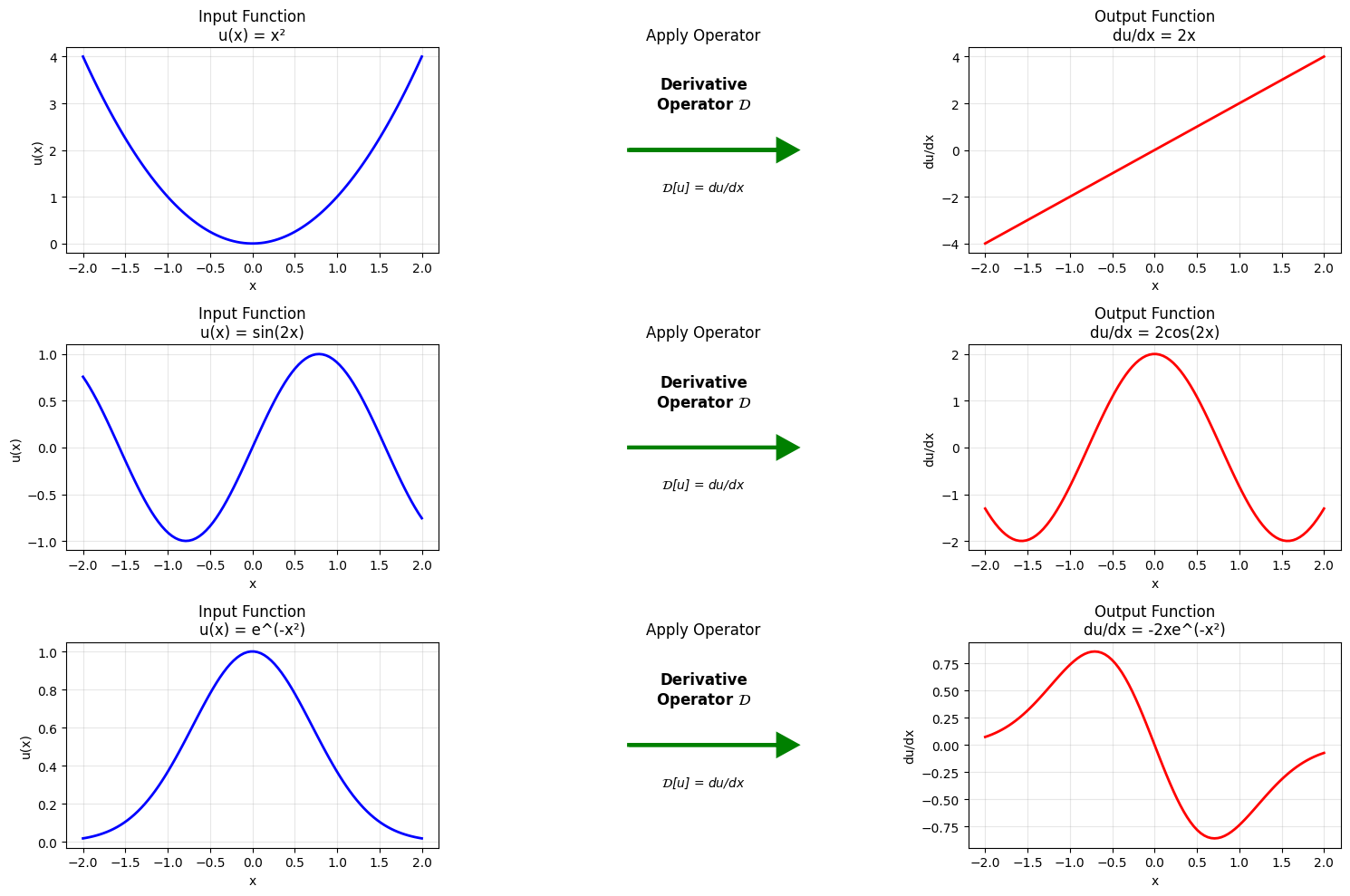
Operator Learning: The Next Level
Now imagine:
- Input: An entire function \( u(x) = \sin(x) \)
- Output: Another entire function \( \mathcal{G}[u](x) = \cos(x) \) (the derivative!)
This is function-to-function mapping: each input function maps to an output function.
Examples of operators we encounter in science:
- Derivative operator: \( \mathcal{D}[u] = \frac{du}{dx} \)
- Integration operator: \( \mathcal{I}[f] = \int_0^x f(t) dt \)
- PDE solution operator: Given source \( f \), return solution \( u \) of \( \nabla^2 u = f \)
Operator Learning
©
|
Cornell University
|
Center for Advanced Computing
|
Copyright Statement
|
Access Statement
CVW material development is supported by NSF OAC awards 1854828, 2321040, 2323116 (UT Austin) and 2005506 (Indiana University)
CVW material development is supported by NSF OAC awards 1854828, 2321040, 2323116 (UT Austin) and 2005506 (Indiana University)