Concrete Example - The Derivative Operator
Perfect starting point: Learn the derivative operator \( \mathcal{D}[u] = \frac{du}{dx} \)
Why this example:
- Simple and intuitive
- Exact analytical solution for verification
- Shows how DeepONet learns basis decompositions
- Bridges function approximation → operator learning
Problem Setup
Input functions: Cubic polynomials \( u(x) = ax^3 + bx^2 + cx + d \)
Target operator: \( \mathcal{D}[u](x) = \frac{du}{dx} = 3ax^2 + 2bx + c \)
Key insight:
The derivative of a cubic is always quadratic, so it can be written as:
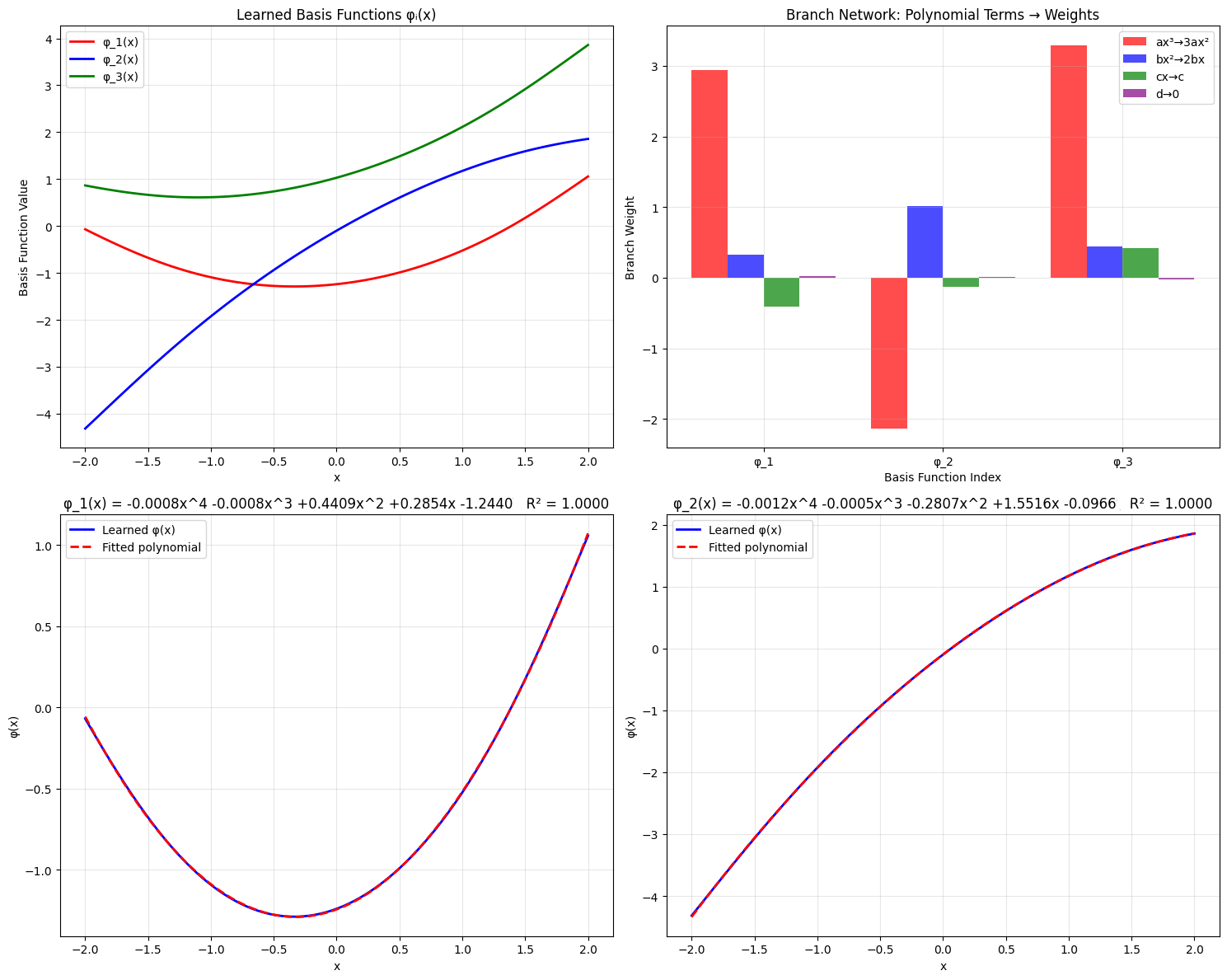
\[ \frac{du}{dx} = w_1 \cdot 1 + w_2 \cdot x + w_3 \cdot x^2 \]
where \( w_1 = c \), \( w_2 = 2b \), \( w_3 = 3a \).
The DeepONet challenge: Can it learn this mapping automatically?
Data Generation for DeepONet
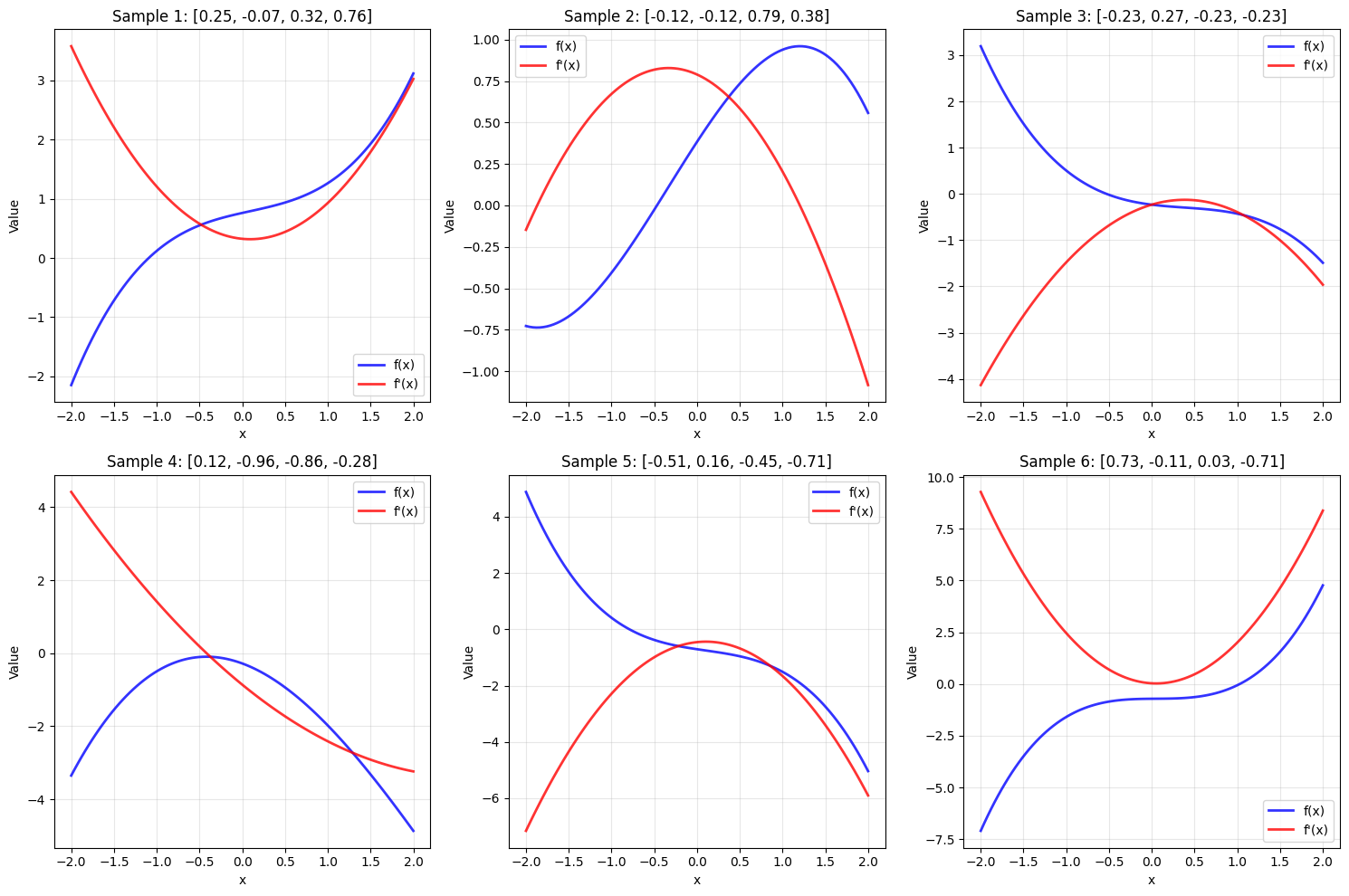
Key Concept: We're learning the derivative operator \( D[u] = du/dx \)
- For cubic polynomials \( u(x) = ax^3 + bx^2 + cx + d \)
- The derivative is \( u'(x) = 3ax^2 + 2bx + c \)
Data Generation
DeepONet Implementation
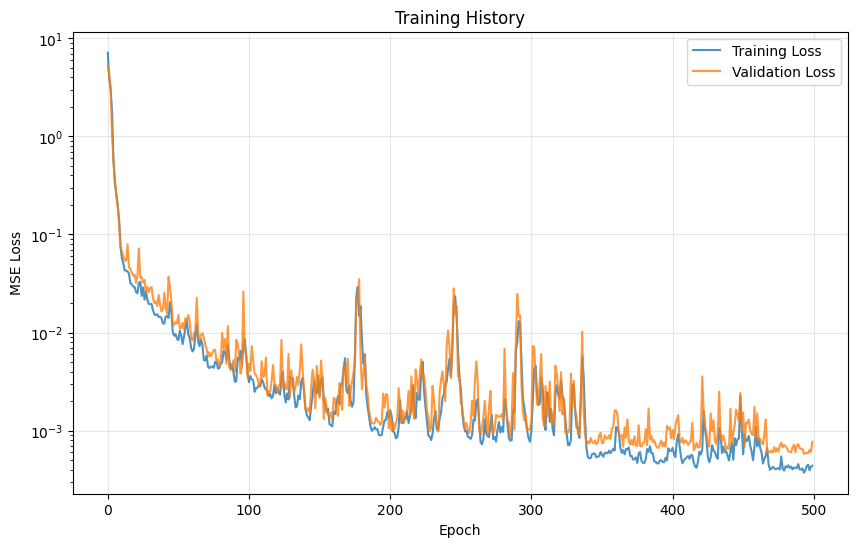
Training
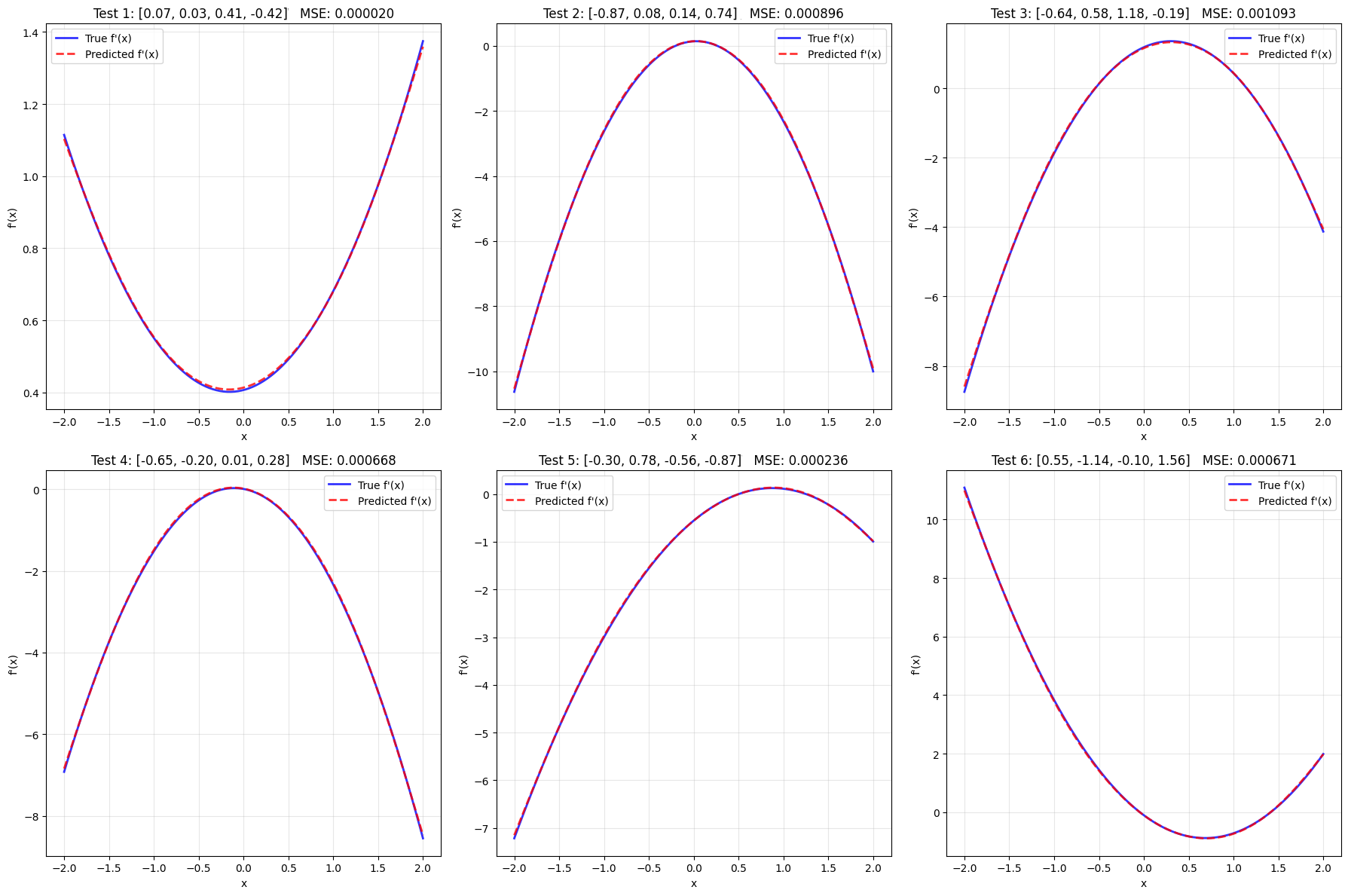
Evaluation of model
Understanding What DeepONet Learned
Critical question: Did DeepONet truly learn the derivative operator, or just memorize patterns?
Let's test it on completely new types of functions it has never seen!
©
|
Cornell University
|
Center for Advanced Computing
|
Copyright Statement
|
Access Statement
CVW material development is supported by NSF OAC awards 1854828, 2321040, 2323116 (UT Austin) and 2005506 (Indiana University)
CVW material development is supported by NSF OAC awards 1854828, 2321040, 2323116 (UT Austin) and 2005506 (Indiana University)