The 1D Nonlinear Darcy Problem
Now for something more challenging: A real PDE with nonlinear physics!
Problem Formulation
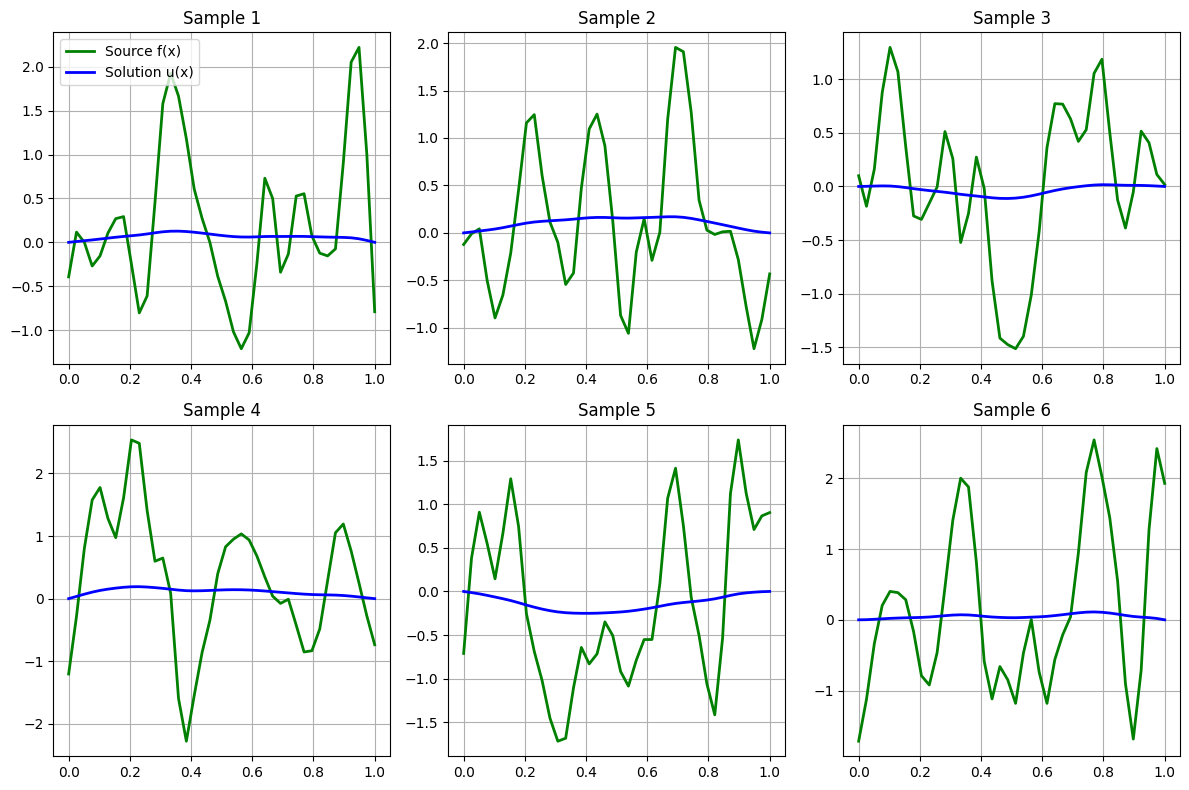
The 1D nonlinear Darcy equation models groundwater flow with solution-dependent permeability:
\[ \frac{d}{dx}\left(-\kappa(u(x))\frac{du}{dx}\right) = f(x), \quad x \in [0,1] \]
where:
u(x)is the solution field (e.g., pressure or hydraulic head).- The \( \kappa(u) \): is non-linear solution-dependent permeability is
κ(u(x)) = 0.2 + u²(x). - The input term
f(x)is a Gaussian random field defined asf(x) ~ GP(0, k(x, x'))such thatk(x, x') = σ² exp(-||x - x'||² / (2ℓ_x²)), whereℓ_x = 0.04andσ² = 1.0. - Homogeneous Dirichlet boundary conditions
u(0) = 0andu(1) = 0are considered at the domain boundaries.
The Operator Learning Challenge
Goal: Learn the solution operator \( \mathcal{G} \) such that:
\[ \mathcal{G}[f] = u \]
where \( u \) is the solution to the nonlinear Darcy equation for source \( f \).
Key insight:
This is much harder than the derivative operator because:
- Nonlinear PDE: No analytical solution
- Random sources: Infinite variety of input functions
- Complex physics: Solution depends on entire source profile
Why This Matters
Traditional approach: For each new source \( f \), solve the PDE numerically (expensive!)
DeepONet approach: Learn the operator once, then instant evaluation for any new source
Let's examine the existing Darcy implementation
DeepONet Architecture
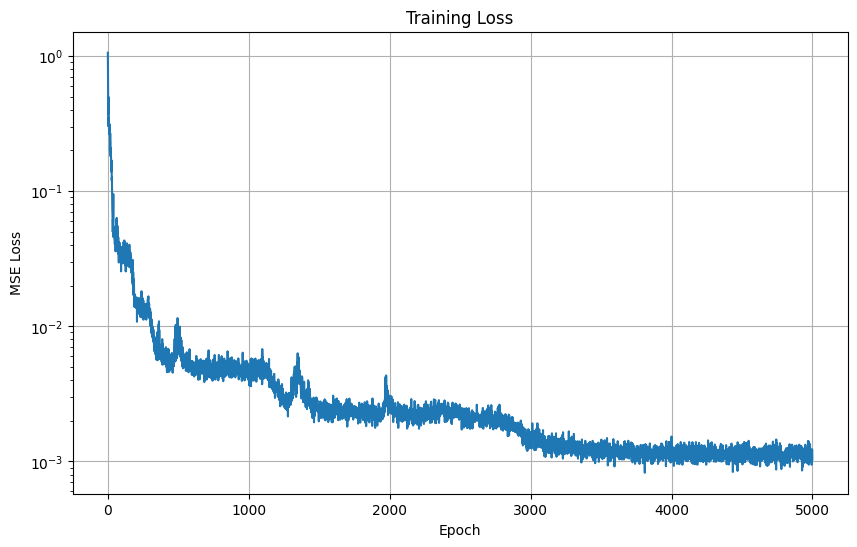
Training
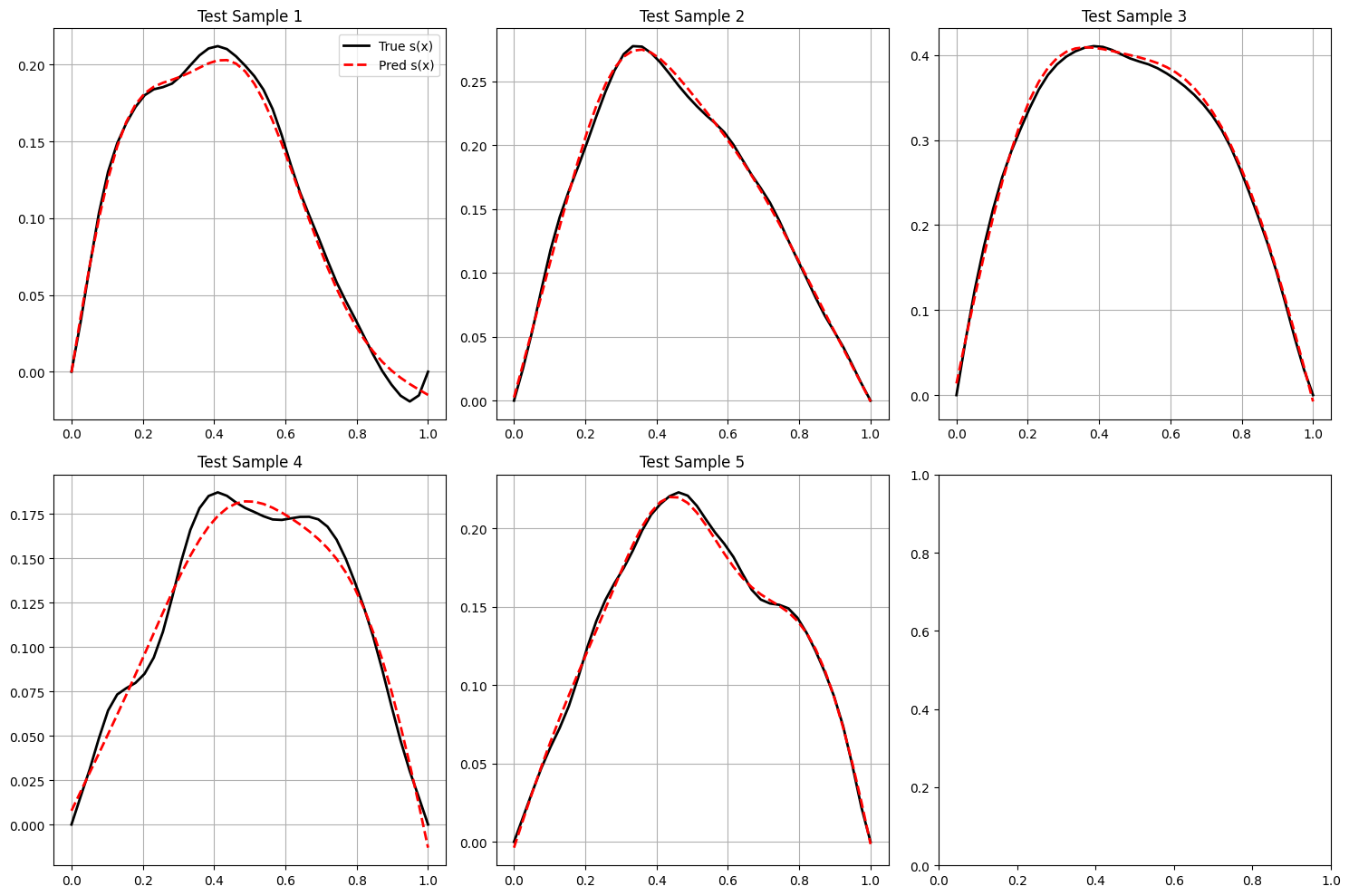
DeepONet Prediction
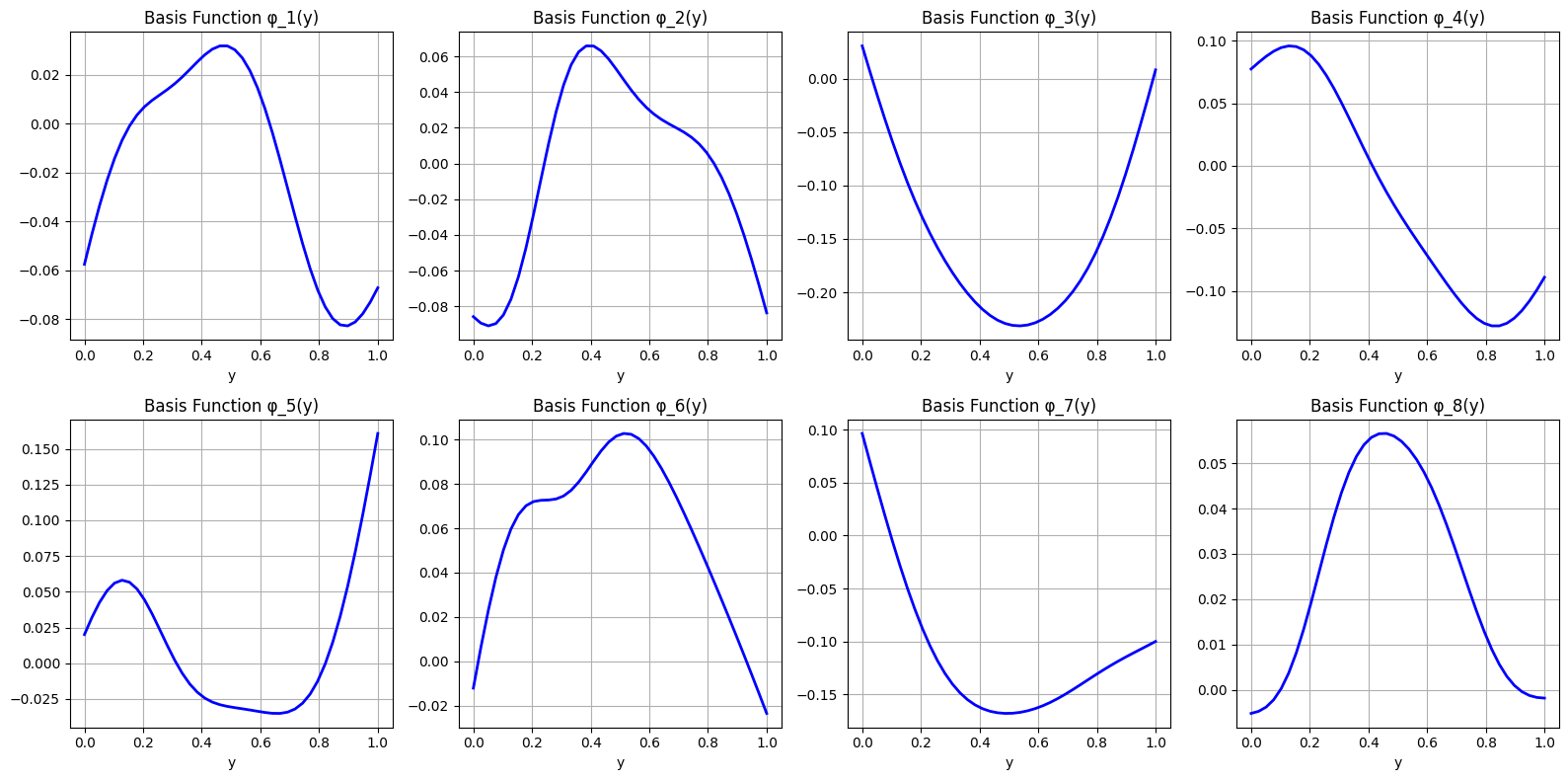
Understanding basis functions
©
|
Cornell University
|
Center for Advanced Computing
|
Copyright Statement
|
Access Statement
CVW material development is supported by NSF OAC awards 1854828, 2321040, 2323116 (UT Austin) and 2005506 (Indiana University)
CVW material development is supported by NSF OAC awards 1854828, 2321040, 2323116 (UT Austin) and 2005506 (Indiana University)