The Need for Depth - The XOR Problem: A Historical Turning Point
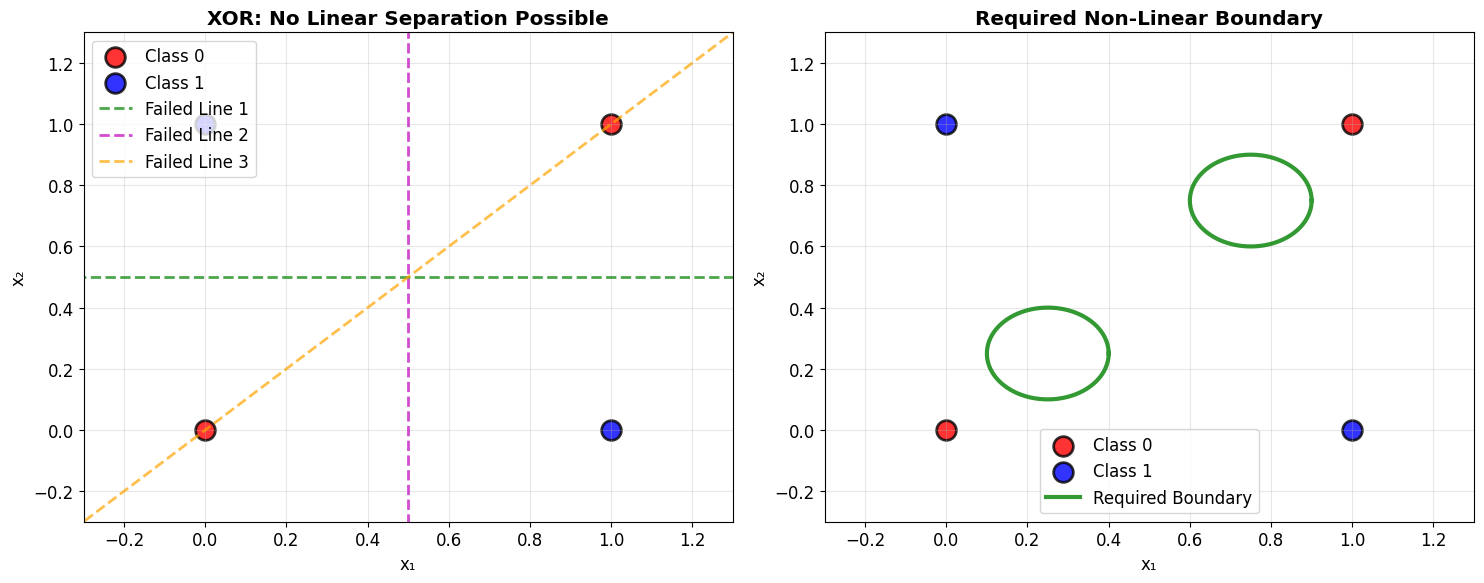
The XOR problem exposed fundamental limitations of true single-layer perceptrons, causing the 'AI winter' of the 1970s. This simple problem reveals why depth is essential.
The crisis: No single line can separate these classes!
The Critical Distinction: True Single-Layer vs Multi-Layer
Historical confusion: What Minsky & Papert analyzed was a TRUE single-layer perceptron (Input → Output directly). This is different from our 'single-layer' networks that have hidden layers!
Architecture comparison:
- True Single-Layer: Input → Output (NO hidden layers)
- Multi-Layer: Input → Hidden → Output (1+ hidden layers)
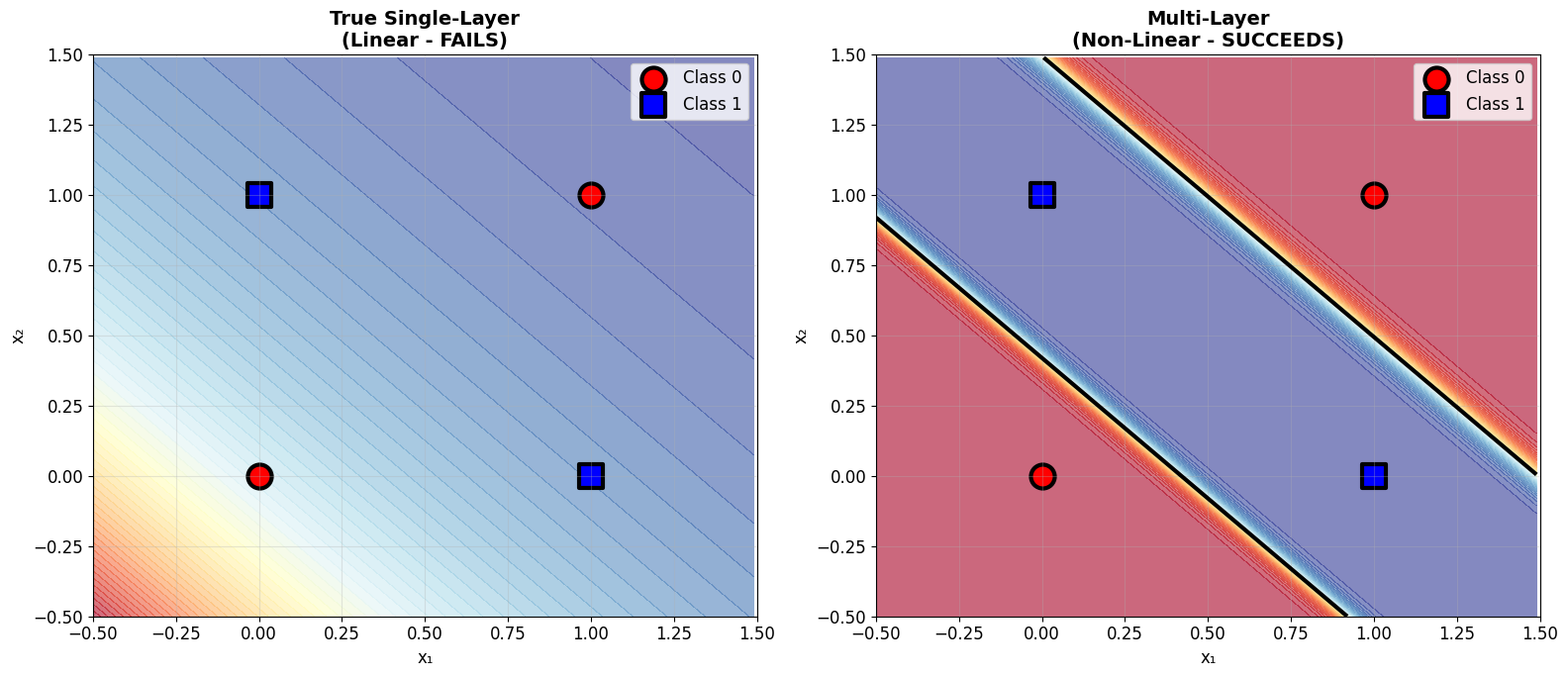
The Historical Failure: True Single-Layer on XOR
Prediction: The true single-layer perceptron will fail spectacularly at XOR.
The Solution: Adding Hidden Layers
Hypothesis: Adding just ONE hidden layer should solve XOR completely.
Visualizing the Decision Boundaries
Linear vs non-linear decision boundaries.
Mathematical Explanation: Why Depth Solves XOR
True single-layer limitation:
Decision boundary: \(w_1 x_1 + w_2 x_2 + b = 0\) (always a straight line)
Multi-layer solution: Decompose XOR into simpler operations
Result: XOR = (OR) AND (NOT AND) = compositional solution!
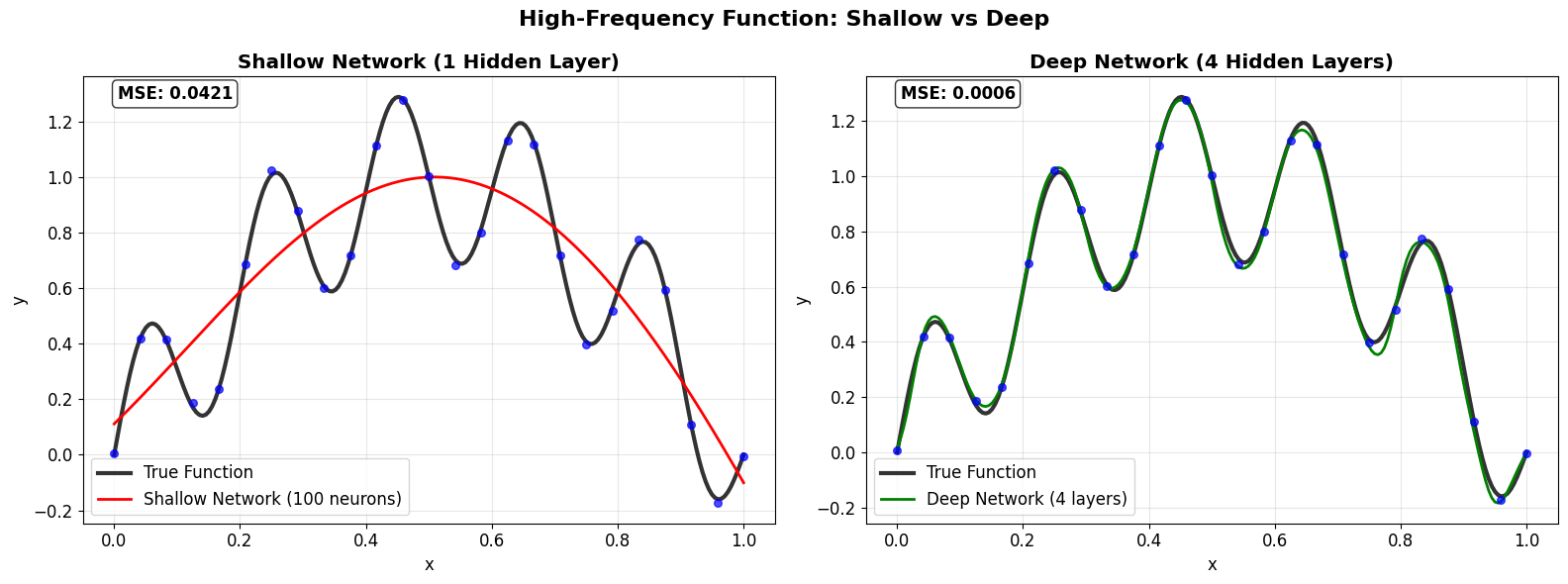
Beyond XOR: High-Frequency Functions
The deeper question: Does the depth advantage extend beyond simple classification?
Test case: High-frequency function \(f(x) = \sin(\pi x) + 0.3\sin(10\pi x)\)
Historical Timeline: From Crisis to Revolution
The XOR crisis and its resolution transformed AI:
| Year | Event | Impact |
|---|---|---|
| 1943 | McCulloch-Pitts neuron | Foundation laid |
| 1957 | Rosenblatt's Perceptron | First learning success |
| 1969 | Minsky & Papert: XOR problem | Showed true single-layer limits |
| 1970s-80s | 'AI Winter' | Funding dried up |
| 1986 | Backpropagation algorithm | Enabled multi-layer training |
| 1989 | Universal Approximation Theorem | Theoretical foundation |
| 2006+ | Deep Learning Revolution | Depth proves essential |
The lesson: XOR taught us that depth is not luxury—it's necessity.
-
Representation Efficiency
- Shallow networks: May need exponentially many neurons
- Deep networks: Hierarchical composition is exponentially more efficient
- Example: XOR impossible with 1 layer, trivial with 2 layers
-
Feature Hierarchy
- Layer 1: Simple features (edges, basic patterns)
- Layer 2: Feature combinations (corners, textures)
- Layer 3+: Complex abstractions (objects, concepts)
- Key insight: Real-world problems have hierarchical structure
-
Geometric Transformation
- Each layer performs coordinate transformation
- Deep networks 'unfold' complex data manifolds
- XOR example: Transform non-separable → separable
- General principle: Depth enables progressive simplification
-
Compositional Learning
- Complex functions = composition of simple functions
- Mathematical: \(f(x) = f_L(f_{L-1}(...f_1(x)))\)
- Practical: Build complexity incrementally
- Universal: Applies across domains (vision, language, science)
CVW material development is supported by NSF OAC awards 1854828, 2321040, 2323116 (UT Austin) and 2005506 (Indiana University)