Stage 3: PINN Implementation
Now the real work begins! Let's implement a Physics-Informed Neural Network step by step.
Step 1: Physics Loss Function
The heart of PINN is computing the physics residual using automatic differentiation:
Step 2: Complete PINN Training Loop
Key Components:
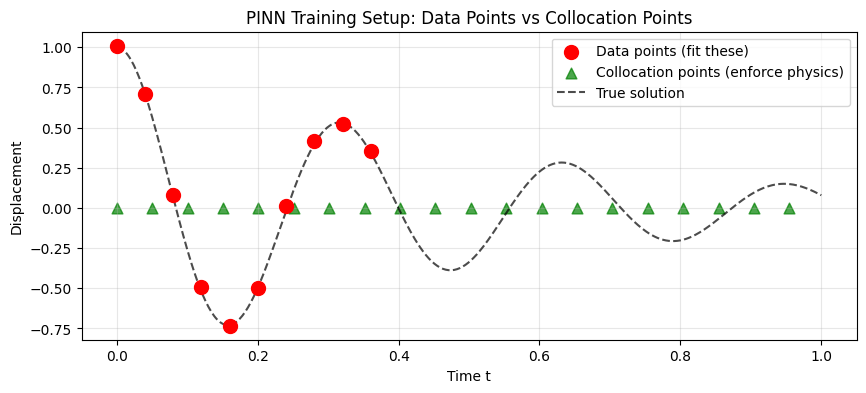
- Data loss: Fit the sparse measurements
- Physics loss: Satisfy the differential equation
- Collocation points: Where we enforce physics (not necessarily data points)
- Balance parameter \( \lambda \): Controls the trade-off
Step 3: Train the PINN
The moment of truth! Let's train the PINN and see if it can learn both the data and the physics:
©
|
Cornell University
|
Center for Advanced Computing
|
Copyright Statement
|
Access Statement
CVW material development is supported by NSF OAC awards 1854828, 2321040, 2323116 (UT Austin) and 2005506 (Indiana University)
CVW material development is supported by NSF OAC awards 1854828, 2321040, 2323116 (UT Austin) and 2005506 (Indiana University)